Reflections from the American Academy of Religion Conference: Insights for Building Ethical, Pluralistic Communities
By: Nevia Selmon

Last week, I attended the annual American Academy of Religion (AAR) conference in Boston — a gathering of scholars, chaplains, organizers, and community leaders working where faith, justice, and civic life meet. Across sessions, conversations converged on themes central to our work at Cohesion Strategy: pluralism that honors real difference, democratic culture shaped by ethical responsibility, and community-rooted leadership capable of holding complexity without collapsing it.
The conference’s presidential theme, Freedom, asked us to grapple with questions that increasingly shape the civic landscape:
Can freedom be separated from justice? Am I free at the cost of another’s dignity? What does genuine mutual freedom look like in a time of polarization, inequity, and global conflict?
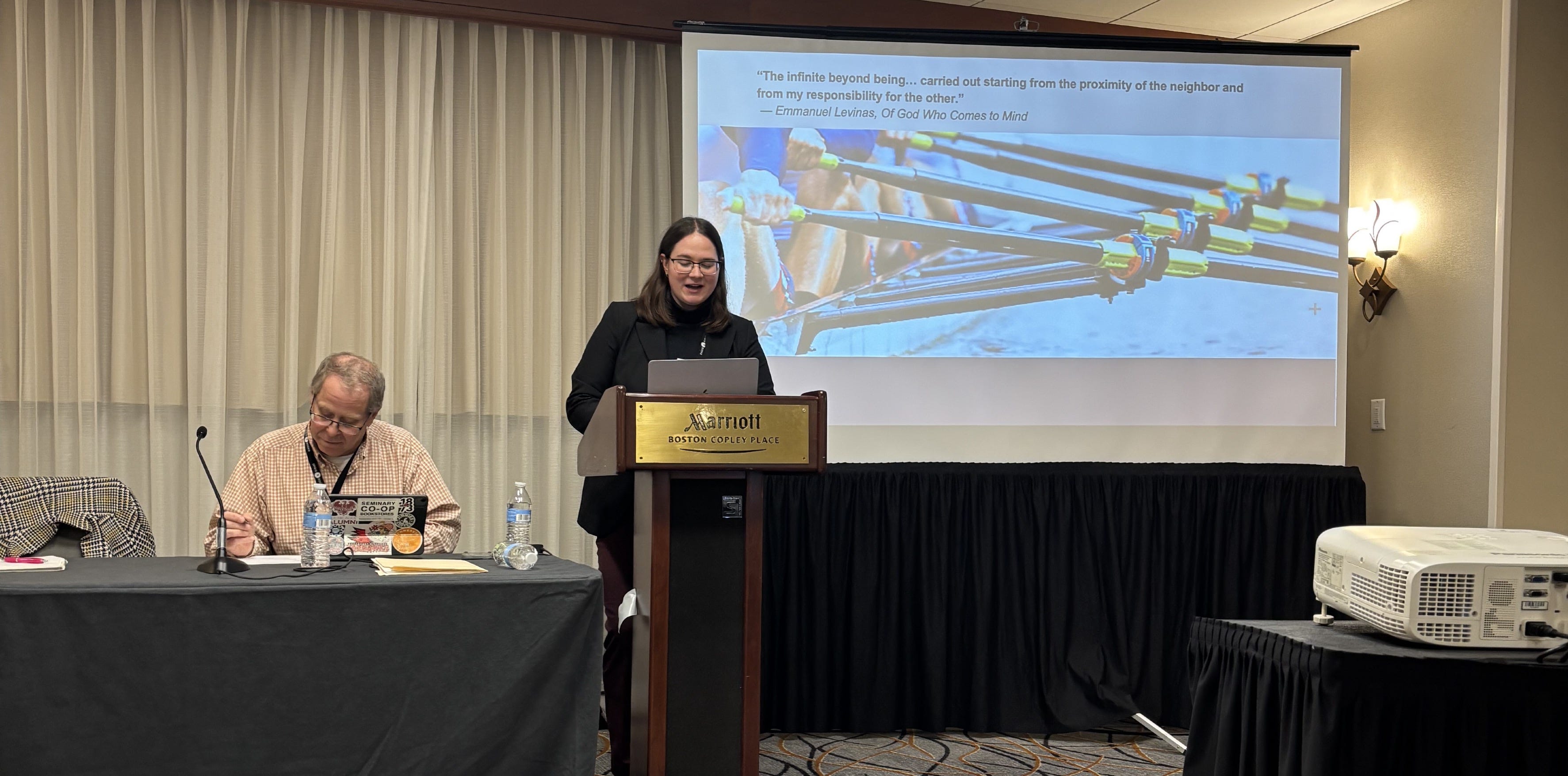
These questions framed how I listened. In my own presentation, I drew on Emmanuel Levinas and Paul Ricœur to explore ethical interdependence through the practice of rowing: a physical model of what shared movement requires. In rowing, collective direction is only possible through mutual responsiveness and the willingness to temper individual ego for the sake of the whole. That same posture — recognizing the vulnerability of the Other and choosing shared responsibility over self-protection — surfaced in session after session. It offered a touchstone for thinking about pluralism, civic resilience, and collaborative leadership.
Below are the key insights I carried home — not as conference notes, but as guidance for the work ahead.
1. Pluralism Requires Rigorous Listening and Shared Inquiry
Rather than focusing on ideological sides, several sessions invited us to imagine civic life as a “community of inquiry.” One early session focused on democratic pragmatism and its implications for civic life. David Lamberth drew on the work of John Dewey, emphasizing that democracy — particularly “small-d democracy” — is rooted in the DNA of pragmatism, built on shared inquiry rather than rigid ideological camps. He noted that populism, too, sits within this pragmatist lineage, though many leaders committed to pluralism hesitate to embrace it because its most visible expressions have been distorted by current political dynamics. Lamberth urged reclaiming these democratic tools rather than abandoning them — grounding populism in curiosity, evidence, and communal problem-solving.
His invitation to step outside binary politics and into Deweyan inquiry aligned closely with what we see in our bridge-building work: that pluralism is sustained through the disciplined practices of listening, questioning, and uncovering shared concerns.
This emphasis on inquiry as the foundation of democratic life echoed in a Fetzer Institute panel exploring how sacred narratives might serve as shared moral frameworks in a pluralistic world.
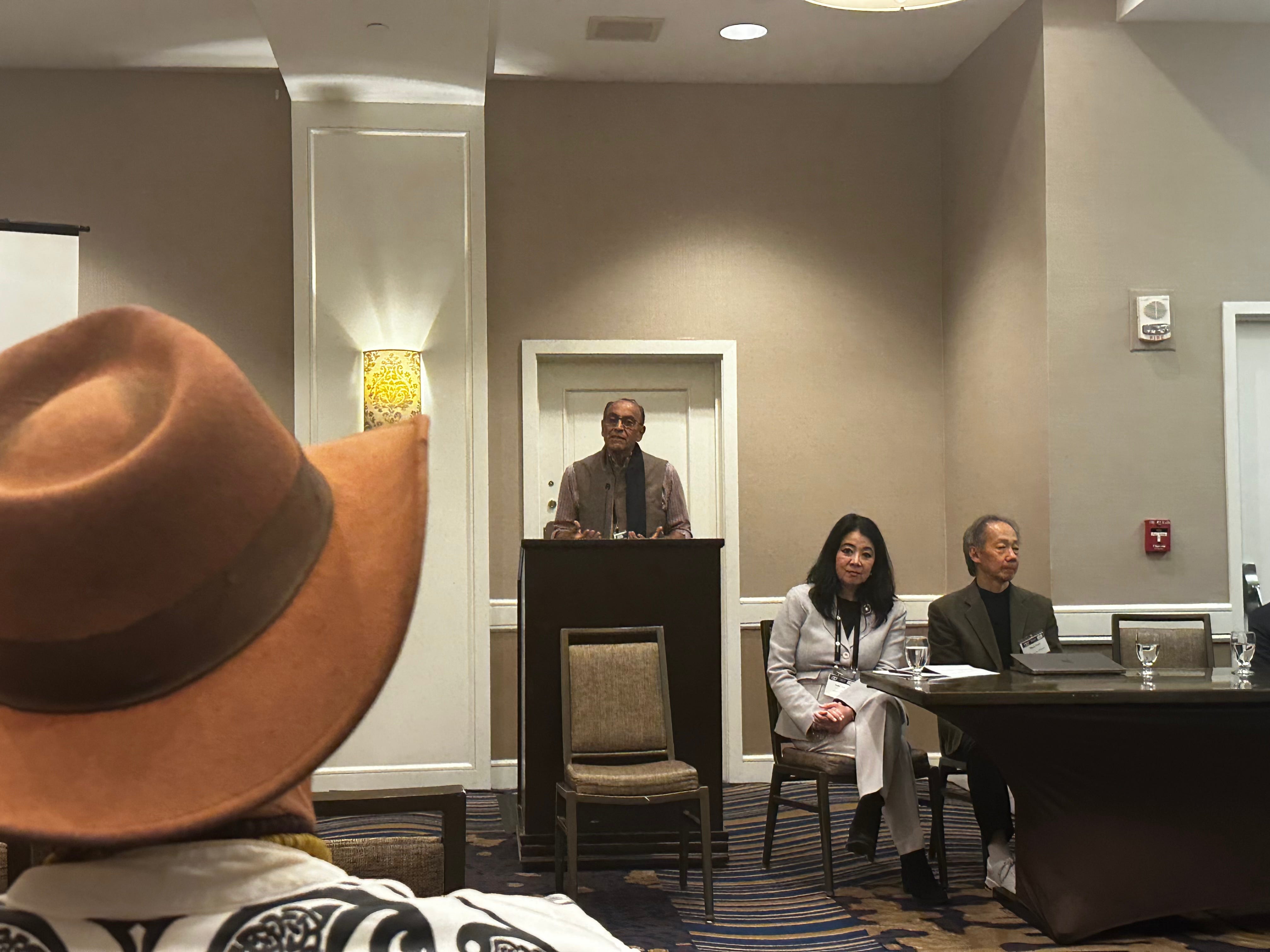
This theme of shared moral imagination appeared powerfully in a Fetzer Institute panel titled “A Shared Sacred Story in a Pluralistic World.” The session introduced the forthcoming volume Our Shared Sacred Story (Orbis, 2025) — a collaborative project gathering scholars and practitioners across Buddhism, Christianity, Confucianism, Hinduism, Indigenous Spiritualities, Islam, Judaism, Sikhism, and Interspirituality. Rather than flattening religious difference, contributors wrestled with whether sacred narratives, revisited through shared interpretation, can help communities respond to global challenges.
Panelists — including Bill Vendley (Fetzer’s VP of World Religions & Spirituality), Anantanand Rambachan, Anna Sun, and Mohamed Elsanousi — explored questions of identity, grief, and belonging. Their reflections rejected naïve universalism and “lowest-common-denominator” sameness; instead, it emerges through deeply situated narratives, careful listening, and the humility to encounter histories and commitments not our own. The session’s rigor and honesty spoke directly to the pluralistic approach we champion: honoring difference while exploring shared ethical responsibility.
Both conversations affirmed something we see often in our partnerships: that bridging difference isn’t about agreement. It’s about creating spaces where dignity, complexity, and curiosity are possible, and where collective imagination can take root.
2. Knowledge Emerges from Proximity, Collaboration, and Shared Movement
Harvard and the Hood: Knowledge Emerges from Proximity, Collaboration, and Shared Movement
A session titled Harvard and the Hood: Religious Scholars and Community Practitioners offered some of the clearest examples of what becomes possible when academic researchers and community leaders work in genuine partnership. Presenters included an organizer leading an interfaith affordable-housing initiative in Colorado, a city planner reframing municipal service as ministry, scholars experimenting with “walking the city” as a method of co-producing knowledge, and Timothy Knepper of Drake University, who has spent more than a decade directing campus–community religious literacy programs in Des Moines. They wrestled with the ethical questions that arise when scholarship meets lived experience: How do researchers enter community spaces without extracting expertise? What responsibilities surface when you “wear two hats” as both scholar and practitioner? And how can academic rigor coexist with accountability to the communities who shape the work?
The peripatetic (“walking”) method especially stood out: learning religious meaning by physically moving through neighborhoods with residents, chaplains, and organizers. It resists surveillance and centers relational presence, reminding us that spiritual and communal knowledge is inherently embodied. Urban chaplain Christopher Valencia deepened this point, describing how slowly accompanying unhoused neighbors transformed his understanding of ministry: “If you slow down, God slows down too.” His work frames chaplaincy not as conversion or instruction, but as shared meaning-making rooted in dignity, listening, and mutual presence.
What emerged mirrors what we encounter in our own work: durable civic solutions take root when researchers, faith leaders, and community practitioners sit in proximity, hold tension honestly, and co-produce insight from shared concerns. Knowledge is not only produced in classrooms or journals; it unfolds through movement, relationship, and long-term commitment to place.me
3. Leadership Thrives Through Networks of Care and Shared Resilience
Research presented on interfaith women leaders highlighted the emotional, relational, and institutional pressures placed on those navigating complex religious and civic spaces. Lower confidence, heightened scrutiny, and burnout were consistent findings. Yet what stood out most were the informal support structures women described: quiet check-ins, encouragement across traditions, and small relational rituals that helped sustain both purpose and well-being.
This affirmed something we lift up often in our leadership development work: resilience is not an individual trait. It is a collective practice. Leaders doing bridge-building work need communities where they can process tension, share burdens, and reconnect to their deeper callings. Strengthening these networks is as essential as any training curriculum.
4. Attentiveness is Emerging as a Core Civic Virtue
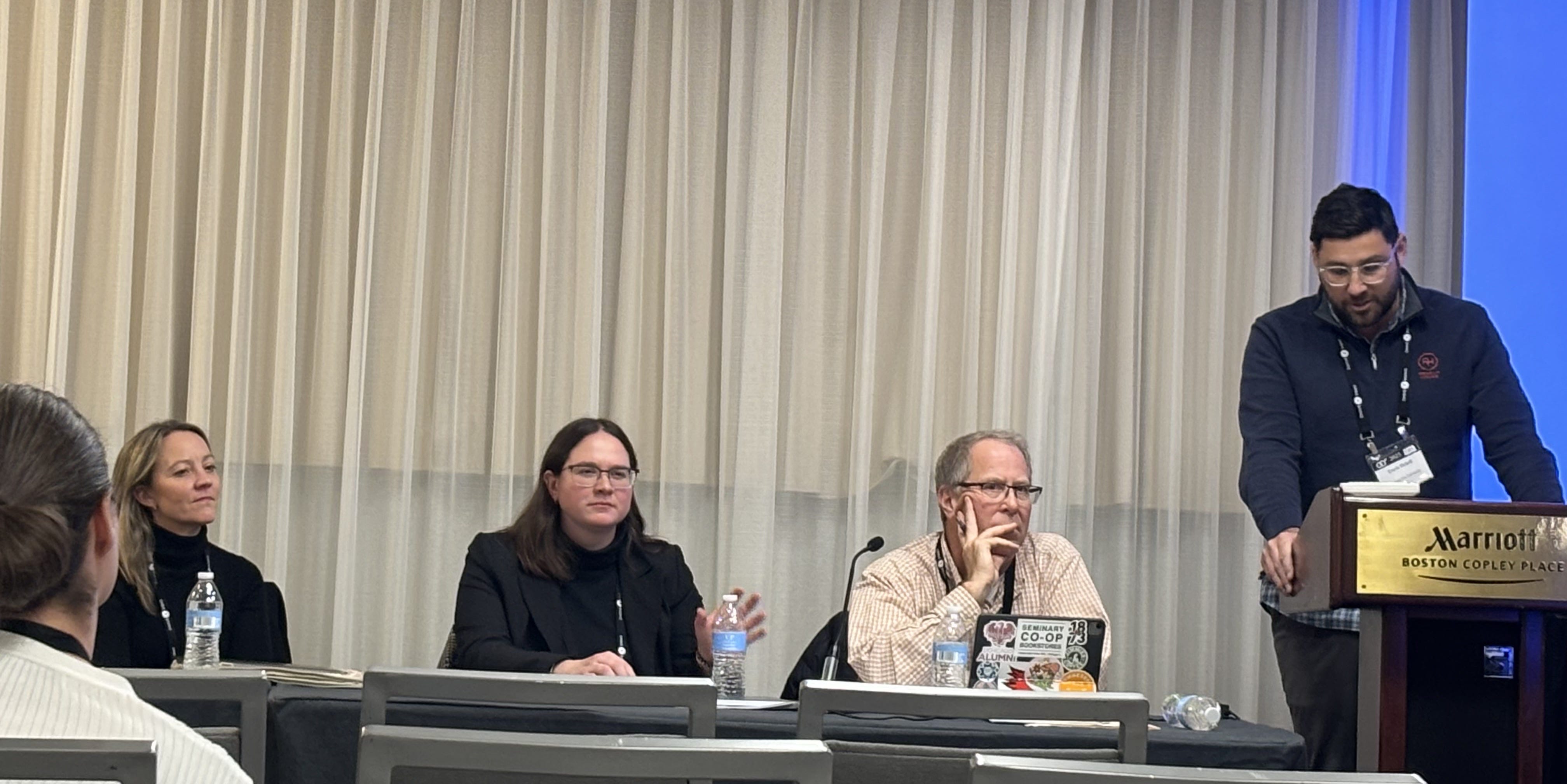
A presentation on “covenantal pluralism” — a developing framework in religious literacy — asked whether attentiveness can be the virtue that moves societies beyond tolerance toward relational commitment. The presenter raised an important question: if knowledge about religions is co-produced through encounter, story, and shared experience, then what matters most is not information alone, but the posture through which we come to know one another. Much discussion centered on whether existing models of religious literacy (knowledge-based, analytic, and skills-focused) go far enough in cultivating the empathy and humility needed for pluralistic democracy.
The session also drew lively critique. Some attendees noted that the language of “covenant” risks privileging traditions in which covenantal imagery carries theological weight. Others observed that the proposal overlaps with existing approaches such as deep pluralism, and that in practice, the dominant literacy models rarely operate in isolation, making sharp distinctions difficult to defend. These tensions were not dismissive; they underscored that pluralism itself is a living, evolving practice, shaped by multiple streams of thought.
What stayed with me was not the framework, but the underlying insight: pluralism is not a technical competency. It is a posture of sustained attentiveness — to histories, identities, inequity, and the humanity of others. And that posture matters not only in classrooms and religious spaces, but in civic institutions, nonprofits, philanthropy, and leadership more broadly.
What This Means for Bridge-Building Leaders
Taken together, these sessions painted a picture of pluralism that is demanding but hopeful. The work requires:
examining our assumptions rather than defending our camps,
building partnerships grounded in relationship rather than extraction,
moving slowly enough to see and honor those directly impacted, and
sustaining leaders through networks of care instead of isolation.
It echoed what AAR’s president asked at the start: freedom without justice is not freedom. When our personal agency rests on the silencing of others, we are not operating from ethical interdependence. The conversations in Boston challenged us to move differently — toward collaborative truth-seeking, shared moral imagination, and practices of attention that refuse to reduce one another to caricature.
At Cohesion Strategy, we see these commitments in the leaders we serve every day. They navigate competing values, polarized environments, and communities longing for clarity and compassion. Our upcoming workshop, Leading When Values Collide, emerges from this very moment: a space for nonprofit and philanthropic leaders to think honestly about ethical complexity, pluralism, and the work of holding communities together.
I left the conference with a renewed conviction that this work belongs not only in academic halls, but in neighborhoods, civic institutions, and board rooms. Scholars, chaplains, organizers, funders, and advisors — we each have a role in shaping communities capable of justice, dignity, and shared flourishing.
And that work starts with how we encounter one another.