
Democracy’s Next Founding: Building the Infrastructure for Collective Wisdom
Reflections from TED Democracy: Founding Futures


By Julia Kemner, Strategic Operations Manager with Cohesion Strategy
Reckoning tells us where we have been. Pluralism helps us determine how we move forward together. Infrastructure makes that movement possible.
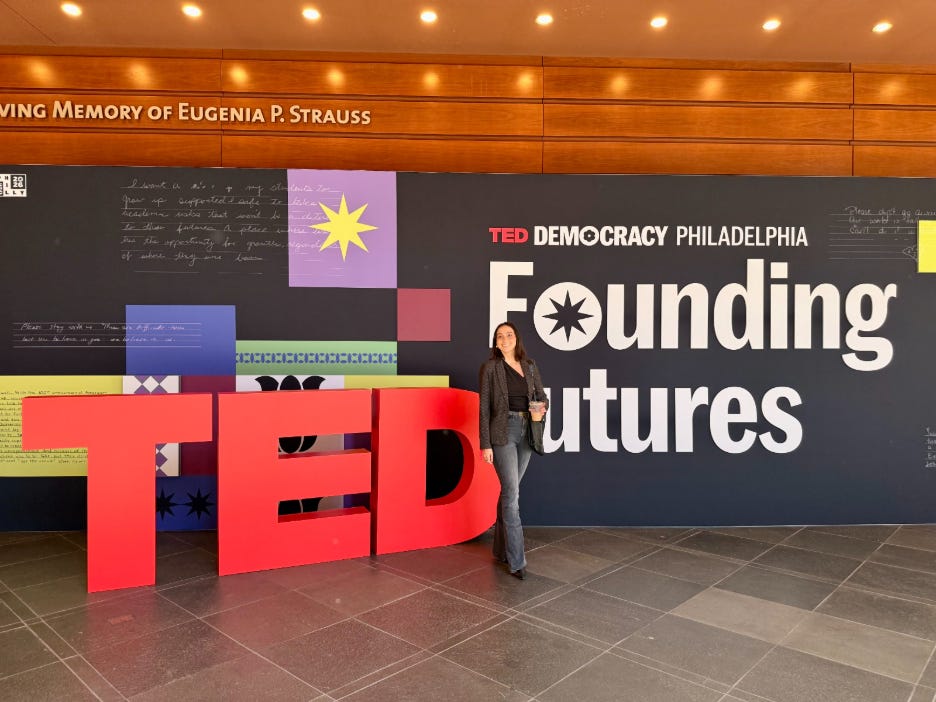
At TED Democracy: Founding Futures on June 13 in Philadelphia, I heard organizers, storytellers, bridge-builders, faith leaders, and democracy practitioners wrestle with a common challenge: How do we maintain confidence in collective wisdom during a period of profound uncertainty?
In plenary, Evelyn Thornton of The Horizons Project, offered to this question a resonate metaphor that stayed with me long after the event ended. She likened the work of pluralists to that of a jazz conductor—organizing counterparts toward harmony and reducing dissonance without removing difference itself; and, cultivating enough shared rhythm to move forward together.
As America approaches its 250th year, I think it’s this distinction – producing harmonies through cultivation rather than removal or replacement – that matters most.
Today, many Americans feel trapped in what Pew researchers have called a democratic “doom loop”—a cycle of polarization, cynicism, disconnection, and declining confidence in institutions. Beneath those symptoms lies something deeper: a growing doubt in collective wisdom itself.
Instead of working through discomfort, many Americans have become resigned to it.
And in our intolerance for ambiguity, we have lost some of the democratic imagination required to carry our founding experiment forward.
Pluralistic Infrastructure for a Connected We
I think we can all agree the escape hatch for this reverberant doom loop is through a reinvigorated connectivity and confidence in our collective wisdom as a nation. Pluralistic practice understands that collective wisdom emerges only when people can understand one another’s experiences, coordinate around shared commitments, learn from what is working, and move through conflict without abandon. And for years, the core focus of pluralists and bridge-builders has been on strengthening relationships across difference with this very wisdom in mind.
Not to be confused - that work remains essential. But concurrently, many pluralistic actors remain fragmented, overstretched, under-networked, and trapped in cycles of reinventing the wheel.
We know pluralism matters – but does it possess the infrastructure necessary to scale the way Americans need to see and feel it?
At Cohesion Strategy, we increasingly believe that infrastructure rests on three capacities:
Ecosystem Intelligence. Coordination. Evaluation.
Together, these capacities transform democratic aspiration into democratic practice.
Ecosystem Intelligence
Rebuilding collective wisdom begins with understanding the ecosystem we inhabit.
Ecosystem intelligence helps us understand where momentum exists, where gaps remain, what tensions are emerging, and what lessons history offers for the present moment.
Without ecosystem intelligence, collective wisdom remains fragmented.
With it, we gain the ability to learn together.
Coordination
If ecosystem intelligence helps us understand the field, coordination helps us move together.
A pluralistic society cannot function without shared civic space.
The freedoms of religion, speech, press, assembly, and petition offer a foundation for cooperation that does not require consensus on politics, theology, or policy outcomes.
The most resilient pluralistic communities are not those where people defend only their own freedoms.
They are communities where people defend the freedoms of others.
That is what transforms pluralism from an ideal into a lived reality.
As debates around faith and public life continue to shape American politics, investing in pluralistic faith leadership, interfaith partnerships, and rights-based coalitions will be essential to maintaining that shared civic space.
Evaluation
The final capacity is evaluation.
Pluralism cannot rely on good intentions alone. It must be accountable to outcomes. We must ask ourselves:
Are attitudes changing?
Are behaviors changing?
Are networks becoming more resilient?
Are communities better equipped to respond to moments of deep conflict or crisis?
Evaluation grounds aspiration in reality. It helps us understand what is working, what is not, and what must evolve.
Most importantly, it rebuilds confidence that collective action remains possible.
If we can build the infrastructure necessary for pluralistic work—and rededicate ourselves to the shared responsibilities of democratic life—we may discover that collective wisdom was never lost.
But waiting to be practiced again.
Democracy Requires More Than Rights
And this brings me back to a recurring theme throughout TED Democracy, that democracy – and the pluralistic practice we need to sustain it – is not self-executing.
Civic storyteller Scott Reich reflected on the origins of Athenian democracy, where citizenship was understood not as something people were born into, but something they became through participation.
The Athenians built systems that guaranteed rights. They also built systems that cultivated civic responsibility, understanding that democratic culture requires practice.
In America, we have inherited powerful democratic institutions but comparatively few pathways that create a shared expectation of civic participation at scale.
The result is a crisis of disconnection.
Trust is exponential in its erosion across institutions, communities, and even family structures. Our challenge is not simply political polarization. It is the weakening of the connective tissue that allows democratic societies to function.
The Opportunity of a Semiquincentennial
The United States has experienced several defining moments of democratic reckoning.
In 1776, we declared independence through a moral creed of equality.
In 1787, we transformed that creed into constitutional form.
Following the Civil War, the nation was forced to expand its understanding of freedom and citizenship.
The Civil Rights era pushed the envelope for inclusion in civic spaces.
As we approach America’s 250th birthday, another reckoning is overdue – one in which we reclaim our collective wisdom with honest, participatory, and courageous resolve to close the gap between our founding ideals and our lived history.
The Work of Owning Our Story
At TED Democracy, Aria Florant of Liberation Ventures spoke about reparations as a broad process of making amends through structural, symbolic, cultural, financial and institutional repair.
I like this framing because it shows that reparations come in whatever form is most resonant to the dignity of the oppressed peoples – because reparations are, most ultimately, about relationships. About acknowledging harm honestly enough that trust can be rebuilt.
The legacy of slavery remains woven throughout our institutions, economy, and civic life. So too does a history of religious exclusion and persecution that has repeatedly tested our commitment to liberty of conscience.
But, in heightened times of polarization, attempts toward reckoning are increasingly treated as distractions from the American story; as acts of division rather than stewardship; as a pervasive threat to national identity.
It’s no wonder we struggle with owning our collective wisdom when we remain fragmented around competing realities – trust in stories we are unwilling to examine.
This is why nations around the world have pursued truth and reconciliation processes, accountability efforts, and restorative initiatives - acknowledging that avoiding reckoning only serves to postpone unity no matter how much we try to preserve it and requires instituting infrastructure that sustains its progress.
Many democracies have learned that truth-telling without infrastructure can produce awareness without cooperative action, and that understanding history and recognizing harms do not equate to understanding or repair.
If America’s 250th year is to become more than a commemorative exercise, we need institutionalized mechanisms for translating reckoning into renewed civic capacity.
This is where pluralism reenters the story.
Learning to Improvise Together
Democracy has never required perfect agreement – just enough trust to remain in relationship through disagreement.
As America enters its 250th year, we must remind ourselves that we will never replace dissonance. We do, however, have a charge to learn how to play together again.
The most reliable path back to confidence in collective wisdom is through pluralistic civic participation coupled with institutional reckoning.
Reckoning tells us where we have been.
Pluralism helps us determine how we move forward together.
Infrastructure makes that movement possible.
We are a people in flux. It’s about time we celebrate the beauty of flux in murmuration, not in its chaos... eh?
____________
If your organization is navigating complexity, values conflict, or cross-difference challenges, we’d be glad to connect for a 20-minute intro call to chat about how Ecosystem Intelligence, Coordination, or Evaluation can help you expand your impact. Alternatively, for organizations seeking quick advice or perspective during high-pressure moments, we offer a limited number of paid one-hour consultation sessions.
 |
|
 | A guest post by
|
We are very aligned! https://drpaulzeitz.substack.com/p/the-third-founding-is-underway?r=d15d7