
Bridgebuilding Effectiveness

In my travels across pluralistic spaces lately, I’ve heard more angst than ever about how to figure out whether bridging works. That’s been especially true as the pressure (from government and from polarized camps) ramps up on nonprofits and on all those crossing divides.
Short answer: I think bridging work is effective in reducing animosity and improving social connectedness... if you do it well. So, this week I’m reposting a combined three-part series on the Effectiveness of Bridgebuilding I co-wrote with Michelle Garred between December 2024 and March 2025.
If you read through and want to hear more, Michelle and I are partnering with Karissa Raskin of the Listen First Coalition and Kristina Kastler of the Packard Foundation to discuss this very topic at Council on Foundations on Thursday May 7.
If you are interested in learning more about evaluating bridgebuilding at your organization, reach me at allison@cohesionstrategy.com or DM me here.
Bridgebuilding Effectiveness: Behavior Matters
Written by: Allison Ralph and Michelle Garred
Michelle Garred, PhD, Founder of Ripple Peace Research & Consulting has partnered with Cohesion Strategy to offer enhanced measuring and evaluation services! Get in touch to learn more.

Over the last couple of months, I, Allison, have written a couple of short pieces on the effectiveness (or lack thereof) of light-touch bridging strategies referencing data showing that the impacts of light-touch bridging strategies often differ from expectations by inspiring less positive change in feeling than hoped. At the same time, I also have a feeling they probably inspire a small number of people to very great changes in feeling and action.
It was somewhat unfair of me, I suppose, to label a great many different approaches as “bridgebuilding” and then attack the whole. So I wanted to clarify that by light-touch bridgebuilding I meant approaches that focus on reducing ill-feeling across difference without directly seeking specific changes in action. Underlying those approaches is the social science theory called “contact theory,” which argues that positive “contact between individuals who belong to different groups can foster the development of more positive out-group attitudes” and presumably a reduction in aggressive behaviors.
As I argued in my earlier blogs, the common focus in the bridgebuilding and pro-democracy space in the US on attitude change alone is problematic for several reasons. Instead, we (practitioners, funders, and evaluators) should be giving equal attention to behavior change as a necessary pathway to social change. So I reached out to my friend and evaluation colleague Michelle Garred, PhD, head of Ripple Peace Research & Consulting and deep expert on understanding behavior (and attitude!) change in dynamic and complex social change situations around the world. I’ve asked her to co-author this blog series with me to:
Explore approaches for evaluating behavior change,
Understand the underlying social science theory, and
Look at some effectiveness tools from the conflict sensitivity and peacebuilding spaces, developed internationally and highly applicable in US contexts.
Michelle and I will begin in this first blog to look at why and how to focus on behavior change directly in evaluation (and possibly applied research) of bridgebuilding initiatives that aim primarily to reduce ill-feeling across difference.
Why focus on behavior change?
I, Michelle, would offer that there are two big reasons for including a focus on behavior change when evaluating bridgebuilding. Let’s unpack those reasons.
First, there is no social change without behavior change. That’s a big statement but, if you think about it, I believe you’ll agree. Can you think of any past example of social change that was not caused by a shift in behavior? Neither can I. Of course, behaviors come in many different forms, ranging from our daily micro-habits to the policies that we make through our collective institutions. But I have never discovered an example of social change without behavior change, and I’m confident that you haven’t either.
This does not mean that attitudes are unimportant! On the contrary, our internal attitudes and mindsets are obviously powerful shapers of our external behavior. This is why I am known for advocating that attitude change be considered in evaluation. Nonetheless, the reality is that there is no direct step from attitude change to social change. Attitude change must manifest itself through behavior change before social change can happen.
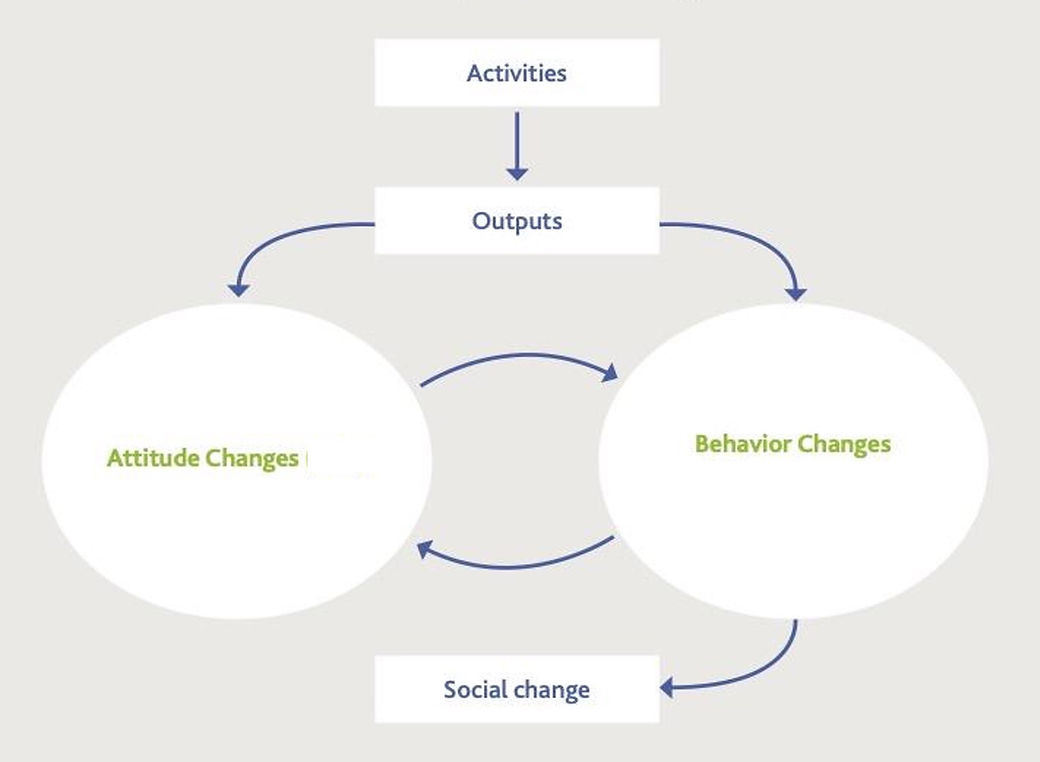
The pathway to social change. Garred with Ma 2024.
Unfortunately, attitude change does not always manifest itself through behavior change. The strength of attitude change’s influence can vary, and sometimes it has no effect on behavior. This challenge has given rise to a significant sub-field of social psychology devoted to researching how and under what conditions attitudes influence behaviors.
Among many other things, social psychologists have discovered that:
The influence of attitude change on behavior change is stronger when the attitude and behavior occur within the same social context.
Gaps in ability or opportunity can block attitude changes from leading to behavior changes.
People who enjoy social privilege sometimes demonstrate a gap between their ethical principles (attitudes) and their real-life behaviors.
These findings are merely a sample of a vast body of research, which affirms that attitude change is important while also warning us not to assume that shifts in attitude lead automatically to changes in behavior. If we want to explore the effectiveness of bridgebuilding, attitude change data is not enough. We must make behavior change data a priority within our evaluation approaches.
Second, behavior change is credible evidence. Attitude change data adds value when it is collected and analyzed well. Yet this is not easy because attitude change can be challenging to measure. It requires individuals to self-report their experience in ways that are often vulnerable to social desirability bias, because we humans are prone to telling evaluators what they want to hear. An attitude change cannot be seen or observed, so it cannot be objectively verified (though it can be triangulated through comparison to other data points). Credible attitude change data can require expert-level skills, which is out of reach for some small bridgebuilding projects.
Behavior change, on the other hand, is directly observable, so it can be verified. Verified behavior changes are typically understood to be credible, robust data. This is why courts of law value eyewitness testimonies, especially when multiple testimonies align. This is also why many of the skills required to collect behavior change data are accessible for non-experts to learn with some training and practice.
To evaluate the effectiveness of bridgebuilding, the ideal is a combined approach that tracks both behavior changes and attitude changes, and their relationships to each other. A self-reported attitude change gains a lot of credibility and meaning when linked to a verified change in behavior! Similarly, behavior change data becomes more useful when accompanied by attitude data that explains why the behavior change happened. With that said, where it’s not possible to look at both attitudes and behaviors together, Allison and I would recommend opting for a focus on behavior change data.
How to focus on behavior change?
In collecting behavior change data, the most common approach is to pre-identify the behavior changes that we are expecting and then collect data on those particular types of change. For example, a bridgebuilding project might choose to track what proportion of its diverse participants begin to use different words when they speak about each other or hold voluntary meetings with people of other backgrounds. If we are confident that we know what behavior changes to look for, this approach can be an excellent one.
But what if we don’t know what kinds of behavior changes to look for? What if a narrow focus on pre-defined indicators risks missing other significant changes that may occur? This is a challenge in complex and tough-to-forecast contexts like today’s USA. The same challenge applies to bridgebuilding projects, which often seek to unleash far-reaching change by motivating and equipping participants to take the initiative and chart their own courses of action. When project participants actually do so, the resulting behavior changes become unpredictable, and it becomes necessary to apply a wide lens when looking for emergent change.
One of the most compelling approaches to tracking emergent behavior change is Outcome Harvesting (OH), originally developed by Ricardo Wilson-Grau. Unlike traditional approaches, OH does not rely on the advance prediction of specific changes. Instead, it uses retrospective logic to identify the significant real-life behavior changes that are being observed on the ground and then works backward to capture and verify the change that took place. This is a mainly qualitative approach, yet it supports quantitative techniques when analyzing patterns in the data.
OH outcomes are observable changes in the behavior of individuals, groups, organizations, or institutions toward which the project in question has made a significant contribution. As described by colleagues at Saferworld, an outcome is something that others do in a new or different way as a result of your work. Those outcomes may be small or large, direct or indirect, intended or unintended, opening up powerful new ways of understanding how communities and systems change.
At this point, you may wonder: “Outcome Harvesting sounds like a really intriguing way to track behavior change! But does it totally ignore attitude change?” Well, yes, it does. OH, in its original form, looks only at behavior, which is a limitation when evaluating bridgebuilding. That’s why my firm Ripple Peace Research & Consulting has led the development of an adapted version called Outcome Harvesting + Attitude Change. This adaptation retains the behavior-centered definition of an outcome while integrating attitude change as an additional component within the data set. It enables us to credibly demonstrate what has changed while also better understanding why and how.
All in all, we want to inspire you to consider a focus on behavior change when exploring the effectiveness of bridgebuilding! Whether you try Outcome Harvesting or pursue a different approach, we hope you’ll give behavior change a try. We’d love to hear about your experiences. Feel free to reach out for further conversation.
Bridgebuilding Effectiveness: Contact Theory Basics
Welcome to the second installment of a three-part series on bridgebuilding, behavior, and effectiveness, co-authored by me, Allison Ralph, and evaluation specialist Michelle Garred, PhD, of Ripple Peace Research & Consulting. This series comes out of some concerns I had about the efficacy of how contact theory is being applied in a lot of bridgebuilding work in the prodemocracy space in the US, and about the frequent focus I see on attitude change in evaluating that work. I reached out to Michelle to ask her to explore these themes with me.
Our first blog, published December 2 explored approaches for evaluating behavior change in bridgebuilding work. Our final piece will look at some effectiveness tools from the conflict sensitivity and peacebuilding spaces, developed internationally and highly applicable in US contexts.
This installment focuses on understanding the underlying social science of contact theory. It’s a brief start-up primer on a very large field of knowledge - and one that we hope will be useful.
What is Contact Theory?
Contact theory was originally developed by Gordon Allport and others in the early 1950s in an attempt to understand and interpret the experience of racial desegregation in the US. In The Nature of Prejudice (1954), Allport argued that personal contact between people of different identity groups can promote positive attitudes toward out-groups–groups we perceive as different from our own–and reduce prejudice. In the seventy years since the theory came out, this basic premise has been tested and studied in both real-life and laboratory settings.
Contact theory informs the central core of many bridgebuilding interventions in the US. Contact has also been adapted and mixed with or married to other theories of change in creative ways. We find this creativity very present in the wider prodemocracy space in the US, with organizations like Tanenbaum Center for Interreligious Understanding, Braver Angels, Millions of Conversations, and BridgeUSA leaning on contact theory, among other strategies, to argue that reducing ill-feeling by contact between people of different groups will improve our social fabric and democracy. For example, Tanenbaum relies on contact and on conflict resolution skills to reduce prejudice across religious difference. Millions of Conversations combines contact work with empathy development to reduce animosity.
Given the ongoing – and worsening – levels of distrust and prejudice in American society, it’s no wonder that contact theory is an important approach. Research on contact theory shows that intergroup contact “does typically decrease intergroup prejudice and hostility – but not always or under all conditions” (Pettigrew and Tropp 2013, p.2). To use contact theory well, we must hold both of those realities in tension at all times.
Underlying the argument that contact does typically decrease prejudice, Pettigrew and Tropp report a modest but consistent reduction in prejudice across 515 intergroup contact studies. They also present evidence that prejudice reduction results are long-lasting, transferrable to other types of prejudice, and may have sustainable impacts on willingness to support policy change to address systemic discrimination.
At the same time, those “not always or under all conditions” caveats are big ones and should not be dismissed. If the right conditions are not in place, contact work can produce no effect, or it can even backfire, worsening intergroup relations. So let’s talk about those conditions of success.
Contact’s Conditions for Success
Allport had originally set out four conditions he believed necessary for contact to work.
1. Equal status during contact;
2. Working toward common goals;
3. Intergroup cooperation; and
4. Support from authorities and/or institutions.
An additional condition has been proposed since (see for example Tropp and Morhayim 2022, p.13):
5. Repeated and sustained contact over time.
A couple of years ago, Linda Tropp and Trisha Dehrone wrote a great Guide to Building Bridges and Meaningful Connections Between Groups that Michelle recommends to help program developers integrate these five conditions successfully. And it is important to get the conditions right, because if they aren’t, the intervention could produce no effect or even make things worse instead of better. Interactions that replicate divisions or exacerbate tensions are often referred to as “negative contact.”
In situations where some groups are less advantaged than others, getting the first condition (equal status) right is particularly tricky. In the US, there are many divisions that affect our social status, and they may all have to be attended to. Race, gender, wealth, education, immigration status, country of origin, religion, sexual identity and orientation, and other factors can all affect personal and collective power. Those external realities influence how people experience mixed groups, and real care in crafting and facilitating the groups is necessary to transform, rather than replicate, those status differences.
In other manifestations of the first condition (equal status), it’s important to note that contact work may have different effects on disadvantaged versus advantaged participants. For example, if disadvantaged participants feel forced or threatened by the status conditions, or do not feel respected by facilitators or other participants, they may have a negative contact experience even if the experience positively affects advantaged participants’ feelings and actions. On the other hand, advantaged participants may end up with more positive feelings about their disadvantaged co-participants, but still exhibit prejudiced behavior. This is called the principle-implementation gap (Dixon, Durrheim, and Thomae, 2017, Saguy et al 2016).
In other examples, “single-identity contact”– which emphasizes a single common overarching identity over all other identities–can end up decreasing the engagement of disadvantaged people in collective action to improve their own situation. This is clearly not desirable, but it can happen because single-identity contact reduces prejudice by reshaping individuals’ sense of group belonging, thus minimizing individuals’ connection to disadvantaged identities, and reducing their ability to recognize and desire to address discrimination (Reicher 2007; Cocco et al 2024, Saguy et al 2009, Saguy et al 2016). In the same way, single-identity contact can lead already-advantaged participants to become less aware of, and less willing to address, discrimination against disadvantaged participants because that identity has been erased (Saguy et al 2016).
Dual identity contact–which encourages the development of an overarching identity while maintaining other personal identities--seems to have less of these negative effects than single identity contact. Dual identity contact interventions aim to develop a shared superordinate identity while also recognizing other subgroups’ identities. This type of contact has been shown to maintain disadvantaged participants’ engagement with collective action to address discrimination, while also improving intergroup relations (Glasford and Davidio 2011). Dual identity contact has also been shown to encourage not just improved feelings for, but greater willingness to act to address discrimination against disadvantaged on the part of advantaged participants (Banfield and Davidio 2013).
For bridging projects in the US, we want to emphasize that contact work cannot afford to disregard social justice and equity work, or vice versa, because in fact the two approaches need each other. There must be a recognition of complementarity and a consistent deep listening to the perspectives of disadvantaged participants within contact projects (Ralph 2024, Vezzali & Stathi 2020 Ch.7, Powell and Menendian 2024).
This appreciation can take many forms. One method is to lean into collective action for social justice as Allport’s second and third conditions of common goals and collaboration. This is the type of approach taken by the Needham Resilience Network in the Boston area, which centers contact in the context of community problem solving. NRN has collectively created “a rapid response and prevention capability to counter hate-based events and foster social cohesion.”
Another approach would be to develop partnerships between contact and collective action organizations, where contact interventions can serve as an introduction and on-ramp to collective action or other pro-democratic projects like deliberative democracy opportunities. We believe this is a growth area for contact-based bridging programs in the US.
In addition to direct contact, some interventions use extended, vicarious, or imagined contact. These forms of contact are often used when groups have few opportunities for meeting directly, or as more scalable types of contact. Extended contact is when an ingroup member is known to have developed a close relationship with an outgroup member. Vicarious contact is when a person observes such contact. Imagined contact merely requires individuals to imagine positive interactions with outgroup members (Brown and Paterson 2016). Pettigrew and Tropp (2013, Chp 3) regard these types of extended contact positively, but some scholars are less sanguine about light-touch interventions like extended or imagined contact. (Paluck et al., 2021).
Contact’s Relation to Political Difference and Pro-democracy Initiatives
Prejudice reduction is an important tool in a multiracial, multiethnic, multireligious democracy with a history of discriminatory policies and social norms. Therefore it is no surprise that many organizations centering contact interventions, whether they are aimed at differences of race, class, or religious differences, bill themselves as pro-democracy organizations. These are sometimes referred to as “bridging” organizations; +More Perfect Union is one such organization.nites the country and strengthens communities through social connection, service, and civic engagement.”
In the current situations of high affective polarization, prejudice between political groups has also been an important target of contact interventions. Braver Angels is one among many contact initiatives aiming to reduce severe prejudice across political parties, a prejudice sometimes called “affective polarization.”
Although the vast majority of contact interventions are aimed at racial or ethnic prejudice, a few study the effects of contact on reducing severe prejudice against political outgroups. Because every situation of difference is unique, affective polarization has its own quirks. Thomsen and Thomsen (2021) found that contact between highly polarized political groups was effective, but only on participants who identified weakly or moderately with their party, leaving out those most polarized who need to be reached.
Among pro-democracy contact and wider prejudice reduction initiatives, there has been a common presumption that reducing affective polarization would result in greater pro-democracy behavior. For example, some initiatives in the American political context connect increased understanding to collaborative problem solving.
However, this assumption may be erroneous. The Strengthening Democracy Challenge out of Stanford University studied 25 light-touch interventions that aimed at reducing partisan animosity (some were extended or imagined contact). Among those interventions that successfully reduced partisan animosity, many had much smaller effects on support for undemocratic processes or for partisan violence. Some backfired, making those aspects worse. These results and others beg the question of whether reducing affective polarization through contact has overall positive results for democracy, and suggest that further research be done (Voelkel et al., 2023).
Concluding Thoughts
We hope that the contact theory concepts we’ve mentioned above - as well as the resources cited - will prove useful to program developers and bridging practitioners. We want to reiterate that across contact work, to really understand effectiveness, evaluations should focus on behavior change as much as possible–see our first blog for the reasons why. While much of the research about contact is very positive about the approach’s ability to reduce prejudicial attitudes, links between attitude and behavior can be tenuous in the real world - mediated by other social norms, and personal stressors and limits.
We also want to emphasize that unintended effects are not unique to contact and democratization work. Such challenges are common in any kind of social impact effort. Unintended consequences, including negative ones, are almost never a reason to stop doing the work. Instead, they are a reason to cultivate the transparency and skills necessary to prevent, mitigate and/or adapt to keep a program design on an effective track. This will be a focus of our next blog.
Finally, we believe that intergroup contact is necessary but probably not sufficient for building cohesive unity in the US. In addition to contact, thriving intergroup relations also need other supports, such as equitable access to opportunities and resources, reliable public safety infrastructure, etc. (Tropp & Dehrone 2022, p.5). This is not unusual; most social problems have multiple facets and so they need to be addressed in multiple ways. We’ll explore some practical resources for thinking about this in our upcoming post.
Bridgebuilding Effectiveness: Tools for Program Strategy and Design
Welcome to the final blog in our three-part series on bridgebuilding effectiveness, co-authored by Allison Ralph of Cohesion Strategy and evaluation specialist Michelle Garred, PhD, of Ripple Peace Research & Consulting. This series arose from Allison’s concerns about certain aspects of bridgebuilding work in the pro-democracy space in the US. She reached out to Michelle to invite her collaboration in exploring these themes.
Our first post, published December 2, explored why and how we advocate a focus on behavior when evaluating bridgebuilding work. Our second post, published January 15, provided an overview of contact theory, which informs the central core of many bridgebuilding interventions in the US. That second post surfaced some uncomfortable realities, namely that bridgebuilding can have unintended effects, and that bridgebuilding may be necessary but not sufficient for building a just, cohesive unity in the US. Michelle unpacks and meets these challenges in today’s final post.
Important: These challenges are not unique to bridgebuilding. Instead, they are common within any kind of social impact effort. These challenges are not a reason to stop doing the vital work of bridgebuilding. Instead, they are a reason to cultivate the skills necessary to design a program wisely and manage it adaptively to keep the work on track, even in a complex, fast-changing context. There are practical strategy and design tools available to help us, and this post highlights two of the best: “Do No Harm” and the “Reflecting on Peace Practice Matrix.”
These evidence-based tools come from the global peacebuilding sector. They were created by CDA Collaborative Learning, an influential international “think and do tank” where Michelle has served as a past senior staffer and an ongoing consultant partner. Just a few years ago, it was difficult to explain the value of these international peace tools to American colleagues, because we Americans did not recognize ourselves as a society at risk for conflict. That moment has now passed; America’s status on the democracy index and our levels of social trust have fallen significantly, and political violence is on the rise. These tools, designed with and for practical use by communities and organizations, are highly applicable within the US context. With that said, the terminology may require some tweaking to ensure resonance with US audiences. (Terminology ideas are welcome, and we’ll share them with CDA, who kindly reviewed this post.)
How to address unintended effects?
Unintended effects are common in social impact initiatives. Some are positive or neutral, and it’s important to notice them so you can adapt accordingly. Some are negative, and those need to be prevented or mitigated as promptly as possible. CDA’s “Do No Harm” (DNH) tool is concerned with unintended negative effects on the relationships between different social groups, as well as strengthening local capacities for cohesion and cooperation.
The core concept of DNH - grounded in multi-country ground-level collaborative research - is that any initiative undertaken within a conflicted context carries the potential to either improve or damage intergroup relationships. In bridgebuilding terms, your efforts to help groups come together also carry the potential to exacerbate the tensions that drive groups apart. The challenge is to identify the problem and adaptively re-design so that the program can avoid unintentional harm and, instead, contribute towards better relationships.
DNH practice is deeply grounded in the discipline of analyzing the local context and the intergroup relationships within it. DNH collaborative research findings demonstrate that every intergroup relationship features both Dividers (factors or tensions that drive groups apart) and Connectors (factors that help bring groups together). Your program will inevitably interact with those Dividers and Connectors. If your program strengthens a Connector, or weakens a Divider, those effects are beneficial for intergroup relationships, and they may be worth replicating or amplifying. On the other hand, if the program exacerbates a Divider, or weakens a Connector, then it is causing an unintended negative effect that needs to be addressed.
Those unintended effects are caused by the decisions and behaviors, sometimes very minute details, that shape the program design and implementation. The solution lies in unpacking your programming assumptions to identify and then modifying the problematic details to improve relational impact. If you are working in a highly polarized context, DNH offers a means for periodic in-depth analysis and re-design throughout the life of your program. At the same time, DNH also equips many practitioners at an intuitive level, becoming a lens that transforms how they see their context and the effects of their own actions.
As an example of DNH-style thinking in action, consider the City of Chicago’s “One System Initiative” just launched to integrate its two shelter systems serving the local homeless population and newly arriving asylum seekers. Chicago prides itself on being a welcoming city, so when the number of asylum seekers increased significantly in 2022 and 2023, the city stood up a shelter system to help accommodate new arrivals, meeting important human needs. At the same time, some felt that Chicago’s local homeless population was neglected and, given the predominant demographics of each group, painful tensions were exacerbated between the city’s Black and Latino communities.
Launched last month, “One System” aims to mitigate this unintended effect by integrating the two systems, providing shelter beds based on need, without segregating or treating people differently based on their immigration status. “One System” is highly promising but not necessarily perfect; there may not be enough beds to meet the overall need, which could again affect intergroup tensions. A DNH lens anticipates imperfection by emphasizing that re-design is iterative, and best informed by the experience of the people most affected. Each re-design should be monitored for its effects on intergroup relationships and modified as needed.
For a deeper dive into DNH guidance, check out the following:
A DNH learner’s manual from CDA.
For interfaith bridgebuilders: an article on the surprisingly transformative effects of DNH in the faith sector by Johonna McCants-Turner and Michelle Garred.
The online library of the Global Conflict Sensitivity Community Hub, within which DNH is the most influential and widely-used tool.
How to address the reality of being “necessary but not sufficient”?
First, if it feels threatening to hear that bridgebuilding may be necessary but not sufficient for building cohesive unity in the US - you can relax a bit. This is true of most social impact initiatives. We affirm that light-touch bridgebuilding - approaches that focus on reducing ill-feeling across differences without directly seeking specific changes in action - are necessary because American life remains highly segregated. Our intergroup dynamics will not improve in the absence of real-life relationships.
At the same time, a single solution is rarely sufficient because most complex social problems are shaped by more than one underlying driver. Contact theorists Tropp & Dehrone (2022, p.5) state that intergroup contact works best when accompanied by at least four other support factors: equitable access to resources, public leadership and norms, public safety, and economic development. Contact theorists also continue to debate the extent to which intergroup contact can influence support for policies that address systemic discrimination - which implies the recognition that good relationships are not sufficient in the absence of fair public policy (Pettigrew & Tropp 2013, p.171).
CDA has a useful tool for thinking realistically about the extent to which your program strategies are positioned for high-level, far-reaching impact and what to do about it. Based on 26 international case studies, the Reflecting on Peace Practice (RPP) Matrix (CDA 2016, Module 4) focuses on two key dimensions of program strategy:
Does the program work toward change at the individual/personal level, or the socio-political level?
Does the program aim to engage “more people” or “key people?” A “more people” strategy reaches out to the general public. A “key people” approach reaches out to pivotal decision-makers (whether formal or informal).
When those two dimensions are arranged in rows and columns, they result in a four-quadrant matrix. Bridgebuilding programs work toward change at the individual/personal level, mostly but not exclusively through “more people” strategies, so they sit most often in the upper left quadrant.
The RPP collaborative research carries some sobering findings:
Any program that stays within just one quadrant, without linking to others, is not sufficient to achieve high-level, far-reaching impact.
A program that focuses on the individual/personal level, without also linking to the socio-political level, will have no significant impact.
When working at the socio-political level, it is necessary to engage both key people and more people to be effective.
This implies that many programs, including some typical bridgebuilding programs, are not solely sufficient for achieving high-level, far-reaching impact.
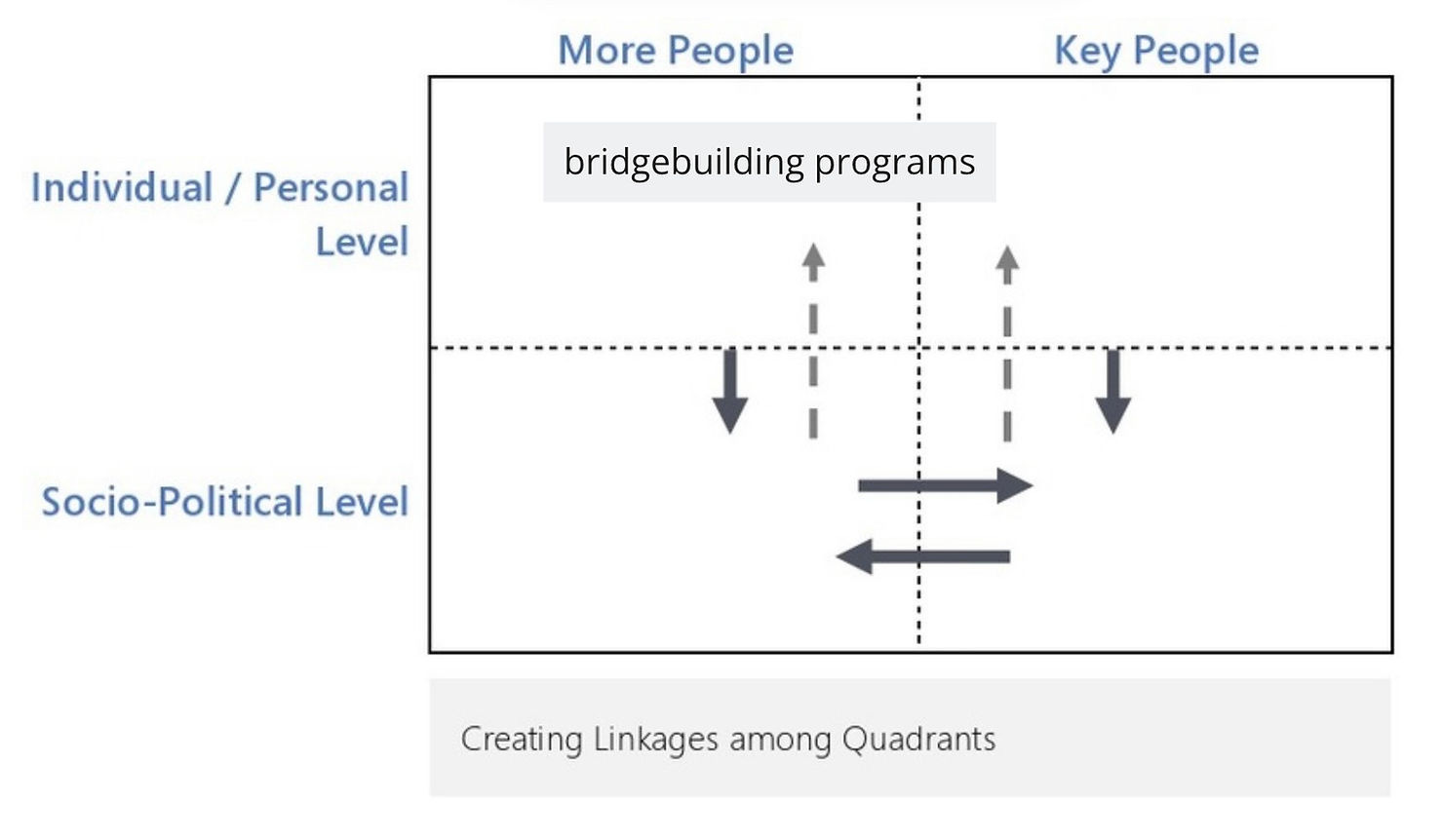
However, the RPP learnings on how to respond to this dilemma are actually quite encouraging. It is understood that most programs cannot operate in all four quadrants simultaneously! There are other options for improvement, such as:
Build linkages over time: As your program progresses into new phases or evolves over time, look for opportunities to extend its activities into other quadrants. For example, the Needham Resilience Network in the Boston area centers contact (upper left quadrant) in the context of community problem solving (lower left quadrant) by creating “a rapid response and prevention capability to counter hate-based events and foster social cohesion.”
Create linkages through partnership: Partner closely with organizations working in other quadrants to create synced-up operational linkages that shift the experience of some or all program participants and enhance cross-organizational learning. While some organizations can do this linking work on their own, others specialize in supporting those linkages. One such is Better Together America (BTA), which is an organization helping others create these linkages. BTA supports a nationwide network of local “civic hubs,” each of which connects a wide range of pro-democracy organizations. The purpose is to provide a shared, pro-democracy identity, to build relationships between the organizations, and ultimately to create unique, local “ladders of engagement” for individuals to move from relationship-building, to community service, civic education, bridgebuilding, deliberative democracy, and civic action.
Recommendations for Funders
Where Michelle brings expertise in peacebuilding and social justice practices, Allison has experience working with the American philanthropic sector, particularly in the pluralistic and pro-democracy spaces.
It appears to us that the learnings from the global peacebuilding space have some big strategy implications for pro-democracy and pro-pluralism funders here in the US.
Based on conversations held on background, we know that pro-democracy funders are keenly aware of effectiveness and value-for-money questions in allocating their overall portfolios and in engaging specifically with the work of bridgebuilding.
Despite such real concerns and our recognition that bridgebuilding work is not solely sufficient, we still believe it is necessary. Donors can provide the encouragement and support necessary for light-touch bridgebuilding programs to make use of DNH to prevent and mitigate unintended negative consequences, and to expand their work beyond a single quadrant according to the RPP matrix. When bridgebuilding extends into the socio-political dimension it may look like: participants influencing norms and behaviors at a community-wide level, taking action together on social issues of shared concern, creating new intentionally diverse civil society institutions, and/or transformatively desegregating the institutions that already exist.
In this moment of urgency, and while bridgers already struggle for funds, another readily available option is for bridgers to build partnerships with other organizations doing deeper work on policy, civic engagement, civic assemblies, and other pro-democracy work, especially if it is transpartisan. Bridgebuilding brings something essential to the US pro-democracy space, since democracy in a pluralistic society demands mutual respect, regard and ability to collaborate across diverse social groups. In the absence of healthy relationships between groups, democracy works well only for the advantaged majority, and it may cease to function altogether.
There is some limited evidence that the presence of active and successful citizens’ assemblies has positive impacts not just on participants, but on the broader community. We also know that in policy-change advocacy work, broader transpartisan coalitions have more strategic capacity and are better protected against political backlash.
In the pro-democracy space, light-touch bridgers–and here we include indirect contact and other communications-based strategies–can be a ready source of motivated participants. The vast majority of individual experiences with these approaches may be modest, yet some participants will be inspired to connect to deeper opportunities, including but not limited to engagement in the pro-democracy space. If pro-democracy opportunities are readily available to participants in lighter-touch bridgebuilding, they will be more likely to move in this direction, which is so vital to the current needs of the US.
We see opportunities to encourage collaborations across the spectrum of very light touch (indirect contact or perception gap work), to light-touch (relationship-oriented bridgers), to a voluntarily sustained transformative engagement across groups and/or to integration into local or regional pro-democracy hubs. Funding that intersection of bridgebuilding and democracy, and specifically funding the staffing and overhead that forming, sustaining, and evaluating these collaborations, the overall impact of both bridgebuilding and pro-democracy work could be significantly improved.
Concluding Thoughts
We want to see the essential work of bridgebuilding thrive! This means approaching it with “eyes wide open,” addressing the possibility of unintended effects and reckoning with the reality that individual transformation needs to be expressed in the broader socio-political space. It also means paying close attention to contact theory’s conditions of success, and emphasizing observable behavior changes when evaluating progress. None of these principles are unique to bridgebuilding; they are common across most social impact efforts. Our three-part series has barely scratched the surface of these complex issues, but we hope the condensed learning has been useful to busy bridgers and funders. There is no better moment to work together toward a just, cohesive unity in the United States.